Comfort comes first
Pillows and Throws for a Country Sofa You Can Still Sit On
Build a comfortable sofa arrangement with a small fabric palette, varied pattern sizes and a practical plan for care and storage.
A sofa should invite you to sit down without first moving a small mountain of cushions. Country texture can come from just a few pieces: a plain cover with a noticeable weave, a quiet stripe, and a throw you actually reach for. Begin with your seating habits and the upholstery you already own, then build the smallest useful arrangement.
Leave room for the people who use the sofa
Count the places people really sit, including the corner someone claims for reading. Place the existing pillows where they support those habits. If two people use a compact sofa every evening, a pair of useful cushions may serve the room better than a full arrangement across the back.
Try sitting in each position before adding another piece. Notice whether an arm cushion pushes you forward or a large square blocks a comfortable corner. There is no required pillow count. Keep the arrangement that supports the way your household sits, and give occasional decorative extras a separate storage place.
Give each fabric a different role
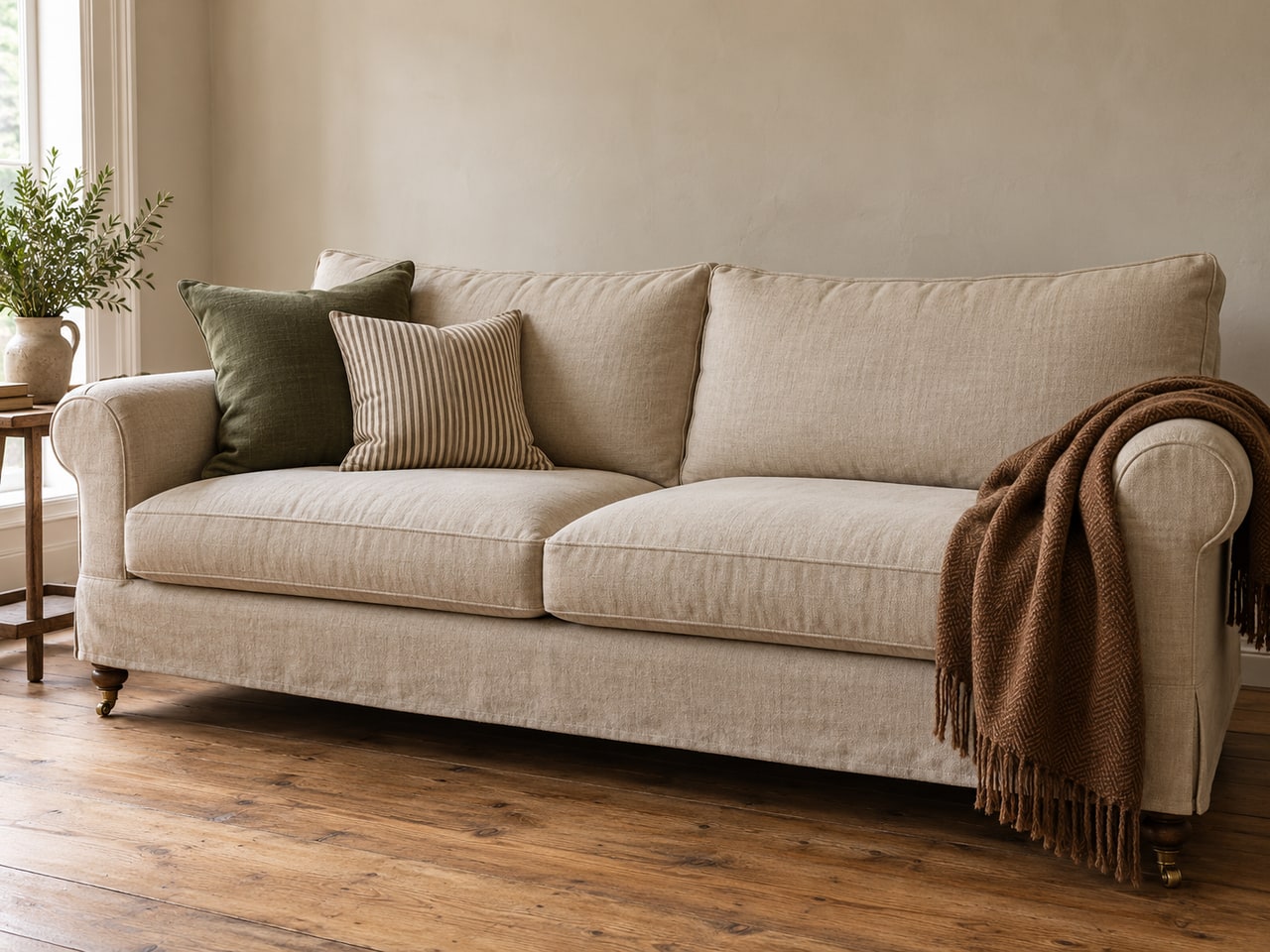
Choose one quiet base, one small pattern and one texture as a starting framework. For example, an ivory woven cover, a muted green stripe and a saddle-brown throw can connect with warm wood and a horse print. These are palette ideas, not a prescribed shopping bundle.
Lay the fabrics together before putting them on the sofa. If every piece has a strong pattern, replace one with a plain textile you already own. If everything looks flat, vary the weave before adding another color. A visible texture can supply interest while keeping the palette calm.
Compare patterns from across the room
A narrow stripe and a larger check can sit together more comfortably when they share a color but have visibly different scales. Two nearly identical busy patterns may compete. Hold the samples at sofa height and step back to the doorway; a pattern that is charming in your hand may disappear or look crowded at that distance.
Let one fabric lead. If you love a botanical cushion, pull one of its quieter colors into a plain companion. Repeat a color already in the room, such as the dark green in artwork or the brown of a side table, instead of introducing a completely separate palette on the sofa.
Match covers and inserts deliberately
Record the finished cover dimensions and check the maker’s recommended insert size. Do not assume every 20-inch cover should receive a larger insert: fabric, seams, closure and the intended fullness all affect the result. Confirm whether a listing includes the insert or only the cover before comparing prices.
Check the closure position and the feel of seams, tassels or buttons where someone will lean. A decorative detail can be better suited to a chair used occasionally than a favorite lounging corner. If replacing only a cover, measure the insert you own and inspect its condition first.
Choose a throw for the person and the task
Measure the throw you already find comfortable rather than relying on the word oversized. Someone covering their knees while reading needs a different size from someone who wraps their shoulders. Check the actual finished dimensions, the fabric feel and the care instructions together.
Fold the throw over one arm or keep it in a nearby basket if it slides off the back every time you sit down. A loose drape is an option, not a daily obligation. If an edge brushes the floor or catches under a seat mechanism, change the arrangement and follow the furniture maker’s clearance guidance.
Give the arrangement an easy reset
Before choosing a pale or textured cover, read its cleaning directions and consider your normal laundry routine. A removable cover is not automatically machine washable. Check each cover and throw individually, and avoid combining pieces in one wash merely because their colors match.
Take a quick photo of the arrangement you like, then live with it through an ordinary evening. In the morning, notice which pieces stayed useful and which landed on the floor. Keep the useful group. Store spare covers flat in a labeled place so a seasonal change can be a simple swap.
A little pause before you finish
Before you call it finished
- Everyone’s usual seat remains comfortable.
- One textile leads and the others support its colors.
- Patterns differ enough in scale to read clearly.
- Cover, insert and throw dimensions are confirmed.
- Care and spare-cover storage fit the household routine.
These are decorating ideas, with illustrative room concepts. This guide contains no paid retailer links. Read our editorial approach.
Back to all journal guides